How it works
The controller is a single binary running two cooperating pieces: a validating admission webhook on pods/eviction, and a reconciler watching Deployments. Neither of them watches nodes, and neither of them polls — the whole flow is driven by the autoscaler’s own eviction retry loop.
The eviction dance
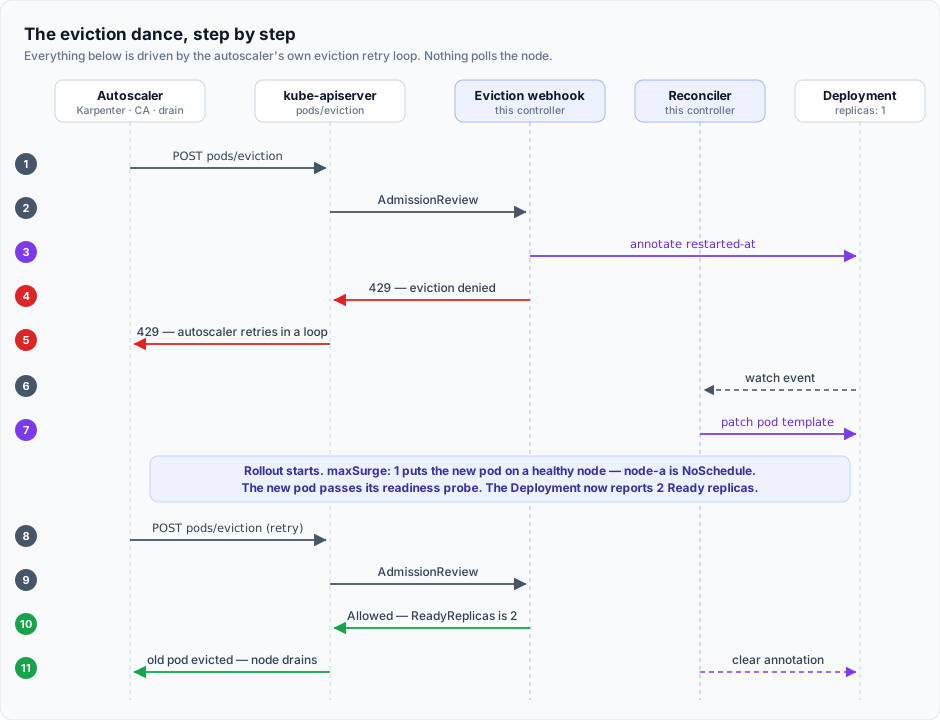
Steps 1–5 — the first eviction attempt. The autoscaler posts an eviction. The API server calls the webhook, which resolves the pod’s owner (pod → ReplicaSet → Deployment), decides the Deployment is eligible, stamps graceful-drain.stonal.com/restarted-at on it, and answers 429. The autoscaler treats a 429 on an eviction as “budget not available right now” and keeps retrying — exactly what it would do against a PodDisruptionBudget.
Steps 6–7 — the rollout. The reconciler is watching Deployments carrying that annotation. It patches kubectl.kubernetes.io/restartedAt onto the pod template, which is what actually triggers the rollout. This is deliberately split from the webhook: admission handlers should return fast and be safe to retry, so the webhook only records intent and the reconciler does the work.
The rollout itself. With maxSurge: 1 and maxUnavailable: 0, Kubernetes creates the new pod before removing the old one. The draining node is tainted NoSchedule, so the scheduler places the surge pod elsewhere. Once it passes its readiness probe, the Deployment reports 2 Ready replicas.
Steps 8–11 — the eviction succeeds. On the next retry the webhook sees ReadyReplicas >= 2 and allows it. The old pod is deleted, the node finishes draining, and the reconciler clears the tracking annotation.
Where the state lives
All of it is in one annotation on the Deployment. There is no in-memory state, no CRD, and no leader-owned queue that matters for correctness.
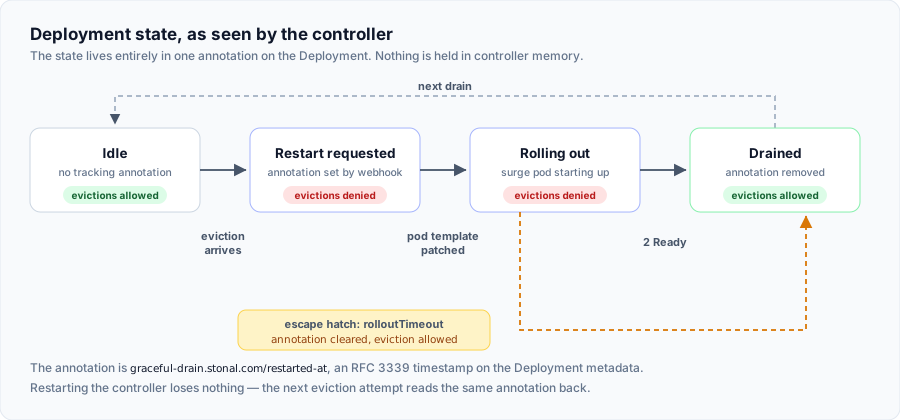
That means restarting the controller mid-drain costs nothing: the next eviction retry reads the same annotation back and continues from where it left off.
The decision table
The webhook allows an eviction — immediately and without side effects — in all of these cases:
| Situation | Why |
|---|---|
| Dry-run request | Admission must not have side effects on dry runs |
| Pod no longer exists | Nothing left to protect |
| Pod has no owning Deployment | StatefulSet, DaemonSet, bare pod — out of scope |
Deployment has replicas != 1 | A normal PDB handles this correctly |
enabledAnnotation is set and the Deployment lacks it | Explicitly out of scope |
| Deployment is being deleted | The workload is going away anyway |
ReadyReplicas >= 2 | The surge pod is up; disruption budget is satisfied |
restarted-at is older than rolloutTimeout | The escape hatch — see below |
| The Deployment could not be resolved, or the annotation patch failed | Never block a drain because of a controller bug |
It denies with 429 in exactly two cases: it has just requested a rollout restart, or a rollout it requested is still in progress.
There is one deliberate exception to “when in doubt, allow”: if the pod itself cannot be read from the cache, the webhook returns 429 rather than allowing. A cold cache right after startup would otherwise look identical to “this pod is unprotected”, and evicting a singleton because the controller had not warmed up yet is the one failure worth being cautious about.
Failure modes, and what happens
The controller is down or unreachable. The webhook is registered with failurePolicy: Ignore, so the API server gives up after timeoutSeconds and admits the eviction. You get the behaviour you would have had without the controller installed — a disruption, not a wedged cluster. If you would rather close that window, run two replicas rather than switching to failurePolicy: Fail.
The rollout never completes — bad image, crashloop, failing readiness probe, no room in the cluster for the surge pod. After rolloutTimeout (10 minutes by default) the webhook stops denying and the drain proceeds. The reconciler clears the annotation and emits a GracefulDrainTimeout warning event. You take the disruption, but the node is not stuck.
The autoscaler runs out of patience first. Every autoscaler has its own drain ceiling — Karpenter’s terminationGracePeriod, Cluster Autoscaler’s --max-graceful-termination-sec. When it expires they stop asking politely and delete the pod directly, which does not go through the Eviction API and therefore not through this webhook. Keep rolloutTimeout comfortably below that ceiling so the controller is the one that gives up first, on its own terms.
The node is drained before the rollout finishes. Nothing special happens. The surge pod is on a different node and continues starting up; the old pod is gone. This is just a normal rollout with an unlucky start.